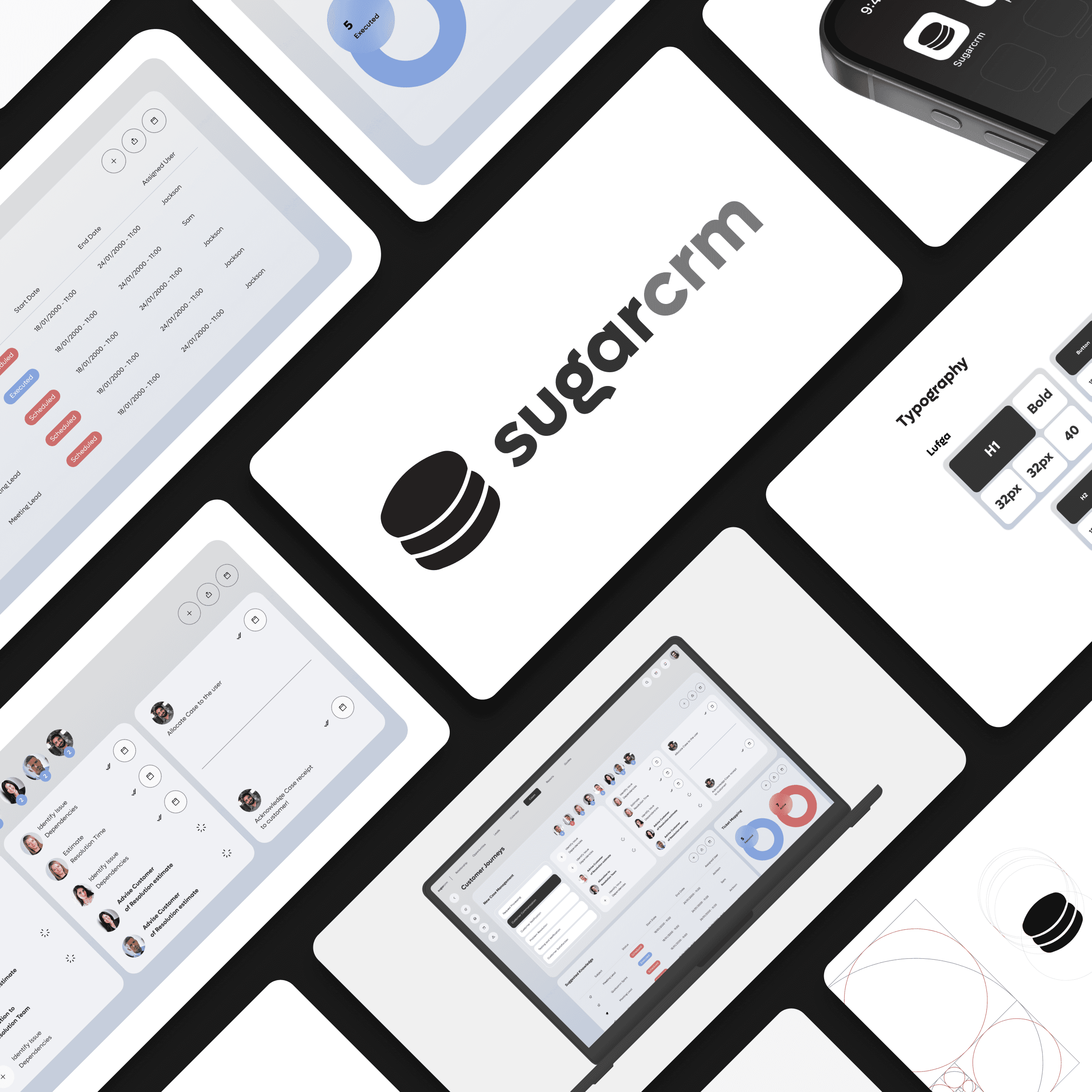
SugarCRM is a robust customer relationship management platform designed to streamline and optimize customer interactions. By offering advanced features such as lead tracking, customizable workflows, journey mapping, advanced analytics, scheduled assignments, and customizable schedules, SugarCRM empowers businesses to drive growth and enhance customer satisfaction.
My Approach
I began by diving deep into understanding the pain points experienced by users managing complex customer interactions. Through comprehensive user research—including interviews, surveys, and usability testing—I identified critical areas for improvement. From there, I developed wireframes and interactive prototypes, iterating based on user feedback to create a seamless, intuitive interface that simplifies customer management while boosting efficiency.
Vision & Innovation
The vision behind this redesign is to reimagine SugarCRM as an intuitive, user-centric tool that transforms complex customer data into actionable insights. The innovative design emphasizes clarity and simplicity, enabling users to effortlessly navigate through customizable workflows, visualize customer journeys, and manage tasks with precision—all without overwhelming the user.
Unique Challenges
Complex Workflows: Simplifying and streamlining multi-step processes without sacrificing functionality.
Data Overload: Presenting complex analytics in a clear, actionable manner to facilitate informed decision-making.
User Adoption: Ensuring the new design is intuitive enough to encourage adoption, even among users accustomed to traditional, cluttered interfaces.
Solutions & Impact
Customizable Workflows: Designed flexible workflows that adapt to individual business processes, ensuring that users can tailor the system to their specific needs.
Journey Mapping & Advanced Analytics: Integrated intuitive visual maps and dashboards that translate complex customer data into clear insights, enabling strategic decision-making.
Scheduled & Customizable Assignments: Developed features to automate task assignments and allow for personalized scheduling, enhancing team collaboration and operational efficiency.
Iterative Process: Leveraged continuous user feedback to refine the interface, resulting in a solution that is both intuitive and highly functional.
User-Centric Design
Every design decision was driven by user needs. The interface utilizes clear typography, a balanced color scheme, and an organized layout to ensure effortless navigation. The focus on user privacy, data clarity, and customizable features creates an environment where users feel empowered to manage customer relationships effectively.
Conclusion
The redesigned SugarCRM project is a testament to the power of user-centered design. By addressing real-world challenges with innovative solutions, this project not only improves the overall user experience but also enhances business efficiency and customer satisfaction. This case study demonstrates that thoughtful, research-driven design can transform complex systems into intuitive, impactful tools for growth.